

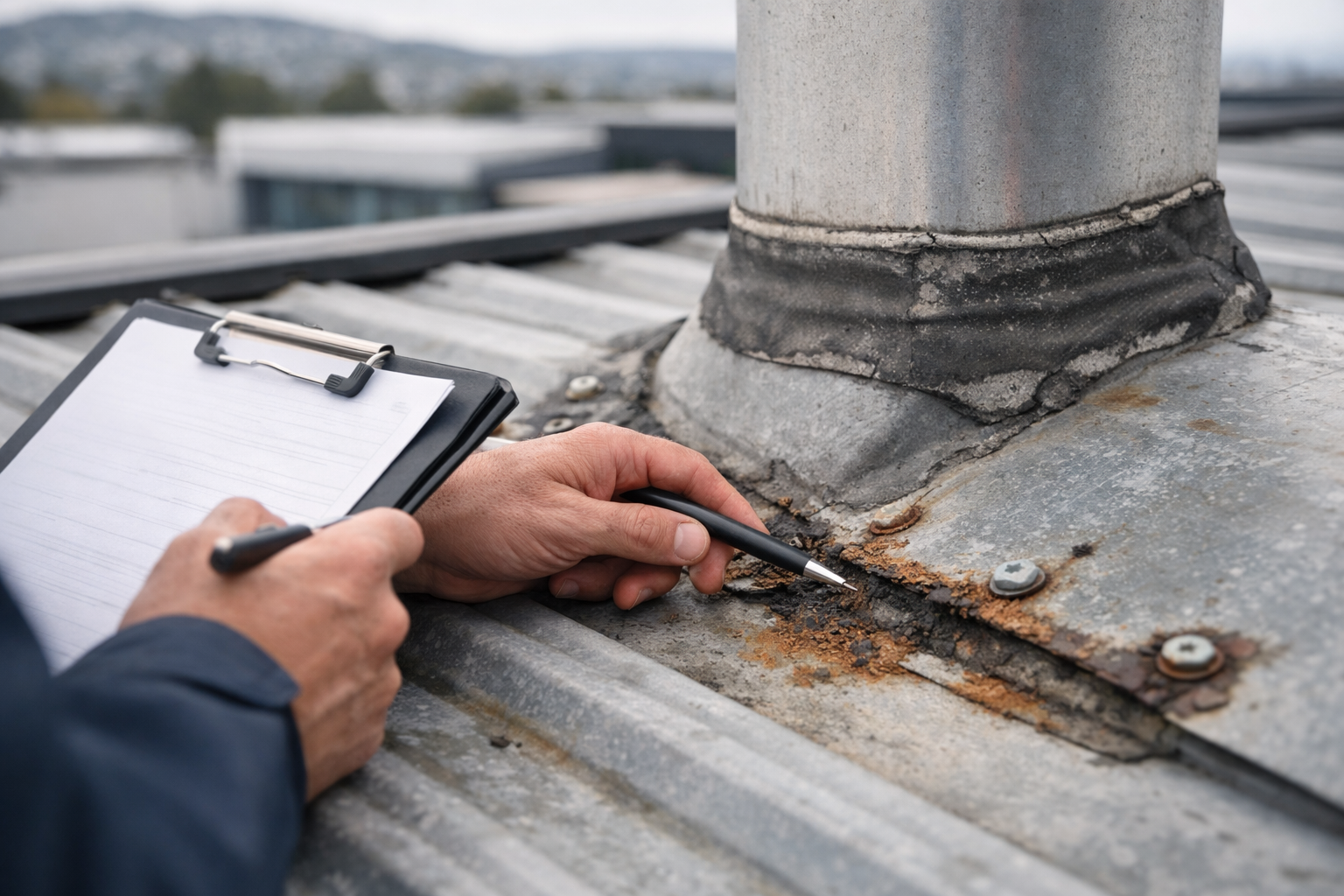
Roofing problems rarely begin with a dramatic failure. In most cases, the warning signs appear quietly and are easy to dismiss. A small patch of corrosion, a minor leak after heavy rain, or a section of flashing that looks slightly out of place. For many building owners, these early signals don’t feel urgent enough to act on.
That hesitation is where risk starts to grow.
Early roofing issues rarely look serious
One of the biggest reasons roofing risks are underestimated is that early-stage problems don’t usually disrupt day-to-day operations. A leak that only appears during certain wind directions or after prolonged rain can seem manageable. Temporary fixes often create a false sense of security.
What’s less visible is what’s happening beneath the surface. Moisture can travel along fixings, insulation, and framing, spreading well beyond the original entry point. By the time interior damage becomes obvious, repair options are often more limited and more expensive.
Visual checks are not the same as condition assessments
Many property owners rely on casual visual inspections. If the roof “looks fine” from the ground or during a quick walkover, it’s assumed to be sound. Unfortunately, roofs don’t always fail where problems are easiest to see.
Fixing points, junctions, penetrations, and concealed overlaps are common failure areas. These are also the places least likely to be noticed without a systematic assessment. A roof can appear intact while still allowing slow, persistent water ingress.
This gap between appearance and performance is one of the most common early-stage misjudgements.
Weather patterns amplify small defects
New Zealand’s climate plays a major role in how roofing issues develop. High winds, driving rain, coastal air, and temperature fluctuations all place stress on roofing systems. A detail that performs adequately in calm conditions may fail under sustained exposure.
Small defects can worsen quickly when weather events become more frequent or intense. What felt like a minor concern during installation or inspection can escalate into a recurring problem once seasonal patterns change.
Deferred decisions compound future costs
Another common issue is delaying decisions until failure becomes unavoidable. Budget cycles, tenant considerations, or uncertainty about long-term plans can all encourage a “wait and see” approach.
The challenge is that roofing systems don’t pause deterioration while decisions are deferred. Materials continue to age, corrosion spreads, and water exposure weakens surrounding components. By the time action is taken, the scope of work is often larger than it would have been earlier.
Early assumptions shape the entire project outcome
Once a project direction is set, it’s surprisingly difficult to change course. Early assumptions about roof condition, remaining lifespan, or repair suitability tend to influence every subsequent decision.
If those assumptions are wrong, later stages are built on unstable foundations. This is why early, objective input matters. Experienced roofing professionals, such as Huston Cross, are often brought in not to confirm a plan, but to challenge it before costs and timelines are locked in. Independent assessments at this stage can prevent much larger issues later.
Compliance and safety risks are often overlooked
Roofing risk isn’t limited to leaks and material failure. Compliance requirements, especially around safety and structural integrity, are increasingly important. Older roofs may not meet current standards, even if they appear serviceable.
Government guidance from the New Zealand Ministry of Business, Innovation and Employment highlights obligations around building performance and safety, including the importance of maintaining weather-tightness and structural durability Ministry of Business, Innovation and Employment.
Failing to address these considerations early can expose owners to regulatory, insurance, and liability risks that go far beyond repair costs.
Asking better questions at the start
Underestimating roofing risk is rarely about negligence. It’s more often about asking incomplete questions. Instead of focusing solely on visible damage, early-stage planning should explore:
- How water moves across and through the roof system
- Which areas are most vulnerable under local weather conditions
- Whether repairs extend lifespan or merely delay replacement
- How current materials align with modern standards
These questions are easier and cheaper to answer before problems escalate.
Final thoughts
Roofing risks don’t usually announce themselves loudly. They develop quietly, shaped by early assumptions, delayed decisions, and incomplete assessments. Building owners who take the time to understand roof condition early put themselves in a stronger position, not just financially, but operationally and legally as well.
The most effective risk management doesn’t happen during emergency repairs. It happens at the start, when there is still time to choose the right path.